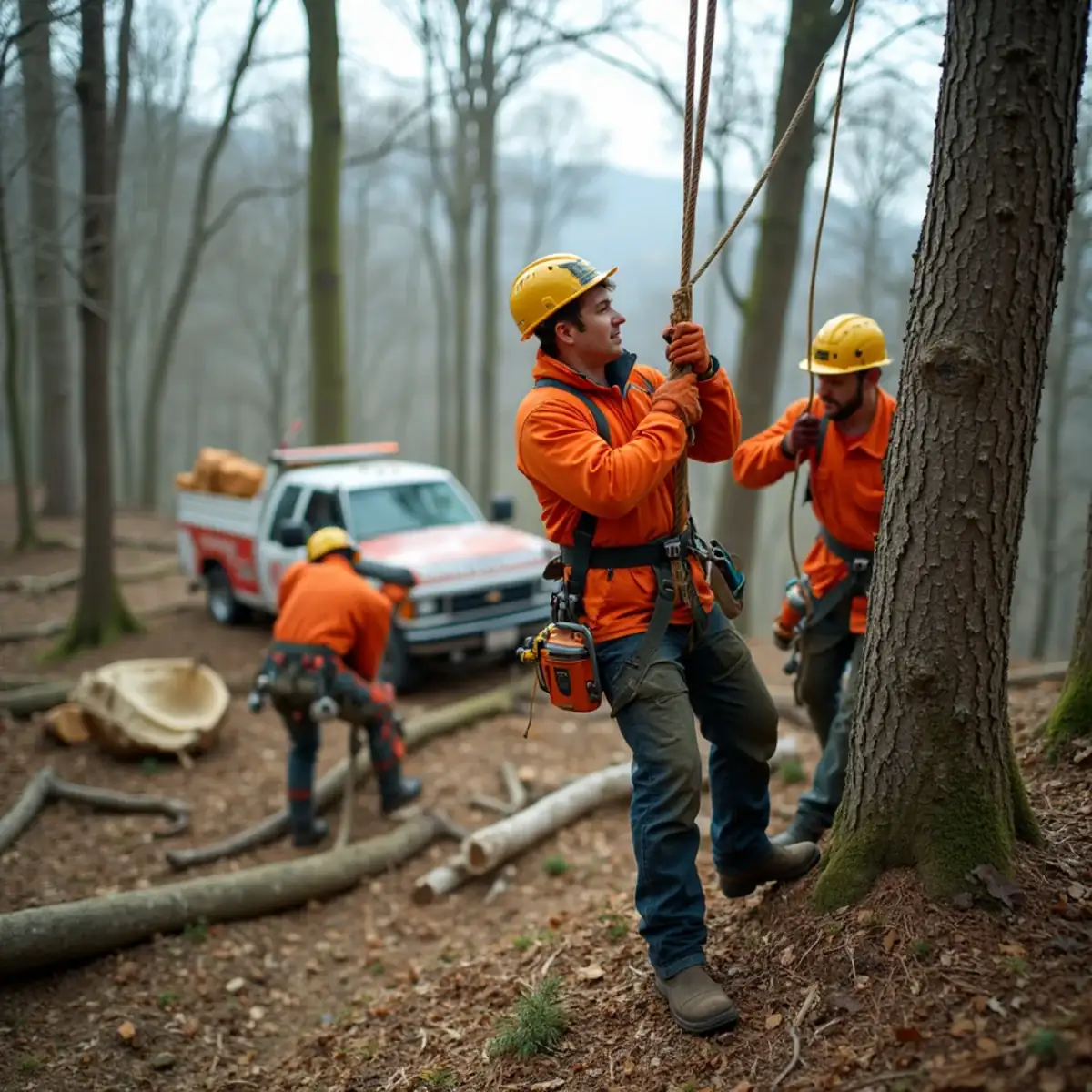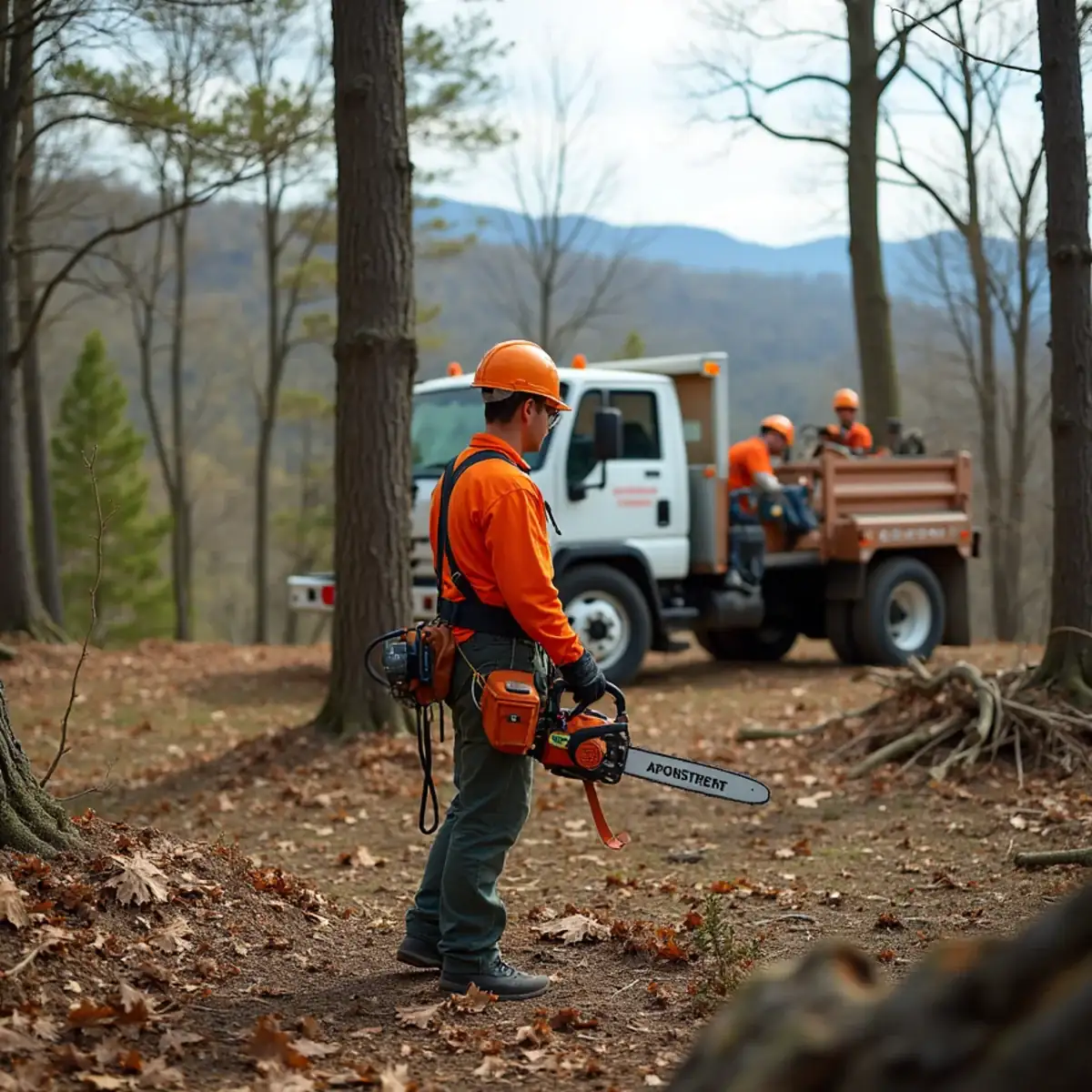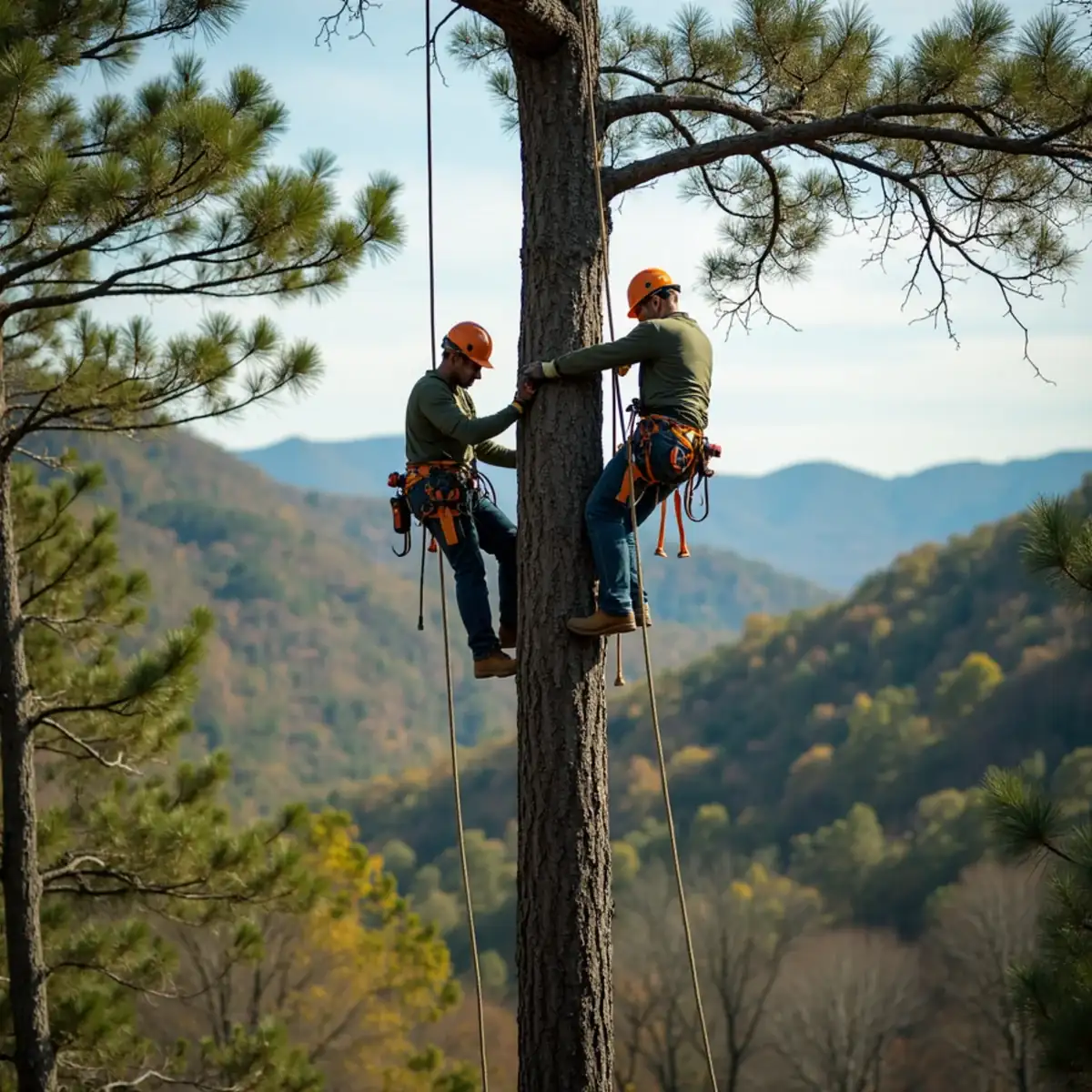
Across the Blue Ridge foothills, plenty of trees sit somewhere a bucket truck will never go — down a steep bank, behind a lake house, wedged between structures, or a mile up a cabin drive. For those trees, the entire job rests on one person's rope skill. That's contract climbing, and it's the work Rig Line was built around.
What contract climbing means
Contract climbing simply means bringing in a specialist climber and rigging crew for the part of a job that demands real technical skill. Sometimes that's a homeowner with one impossible tree. Just as often, it's another tree company that handles routine work but subs out the high-hazard climb to a specialist. Either way, the climber ascends the tree on rope, moves through the canopy, and takes the tree apart from the top down.
Why the foothills demand it
Equipment needs ground to stand on and room to reach. The foothills around Walhalla, Salem, and Mountain Rest offer neither — slopes too steep for outriggers, drives too narrow for a crane, canopies too tall for a bucket. A climber, by contrast, only needs the tree itself. Paired with steep-slope and mountain rigging technique, a good climber reaches and removes trees that would otherwise be left as standing hazards.
- Trees on grades too steep for trucks or cranes
- Removals behind homes with no equipment access
- Confined dismantles between structures and utilities
- Dead or storm-damaged trees needing careful, roped takedown
- Specialist support hired by other tree services
Rigging is what makes it safe
Climbing gets the cutter to the wood; rigging controls where the wood goes. Our climbers set anchor points and lowering devices so every cut piece is caught and lowered under control rather than dropped. That's how a large limb comes off directly over a roof or a dock and never touches it. The discipline behind contract climbing and heavy rigging is what separates a clean job from an accident.
How a climber takes a tree apart from the top down
From the ground it can look like slow, methodical work — and that's exactly right. Here's the sequence a technical dismantle follows over a target like a roof, deck, or dock:
- Ascend and inspect — the climber climbs the stem on rope, checking for the decay, cracks, and dead wood that change the plan
- Set the anchor — a rigging point is established above the first piece to be cut, and the ground crew takes the rope onto a lowering device
- Clear the top — the canopy comes off in small, controllable pieces first, reducing the tree's weight and sail area
- Rig the big wood — heavier trunk sections are negative- or tip-tied so the rope catches them the instant they're cut free
- Lower, don't drop — each piece is eased to a defined landing zone, processed, and cleared before the next cut
When a crane joins the climber
For the biggest, deadest, or most dangerous trees, we pair the climber with a crane. Instead of rigging each piece down through the tree, the crane holds a section while the climber makes the cut, then lifts it up and out over the house to a clear drop zone. It takes the shock loading off the tree entirely, shortens the time a climber spends in compromised wood, and on the right job is genuinely faster and safer than rope-only rigging. Deciding whether a job warrants a crane is part of the plan we build before anyone leaves the ground.
How to tell a real climber from a liability
Because climbing looks impressive from the ground, it's easy to assume anyone up a tree with a saw knows what they're doing. They don't always. If you're hiring a climber — or a company that says it climbs — a few questions separate a professional from a weekend risk you'll be liable for:
- Proof of insurance — general liability and workers' compensation, in writing, before work starts. An uninsured climber's injury on your property can become your problem
- They don't use climbing spurs on a tree you intend to keep — spurs wound the trunk and are only appropriate on removals
- They talk in terms of rigging, anchor points, and lowering devices, not just 'we'll drop it and see'
- They plan the whole job — targets, drop zones, access — before anyone leaves the ground
- They can say when a job needs a crane instead of rope, rather than muscling everything by hand
- They give you a written scope, not a vague verbal number
A specialty rooted in Oconee County
Rig Line's founders are climbers and riggers first, and this remains our signature. Whether you're a homeowner in Oconee County staring at a tree you can't imagine anyone reaching, or a tree company that needs a climber you can trust for one dangerous piece, this is the call to make. When you've got a tree that seems impossible to reach, don't assume it can't come down safely — call us and we'll tell you honestly how we'd do it.
Need help from a real Upstate tree crew?
Free estimates, 24/7 emergency response, fully insured. Call Rig Line Tree Service today.
Frequently asked
If a bucket truck can reach the tree on flat, open ground, a standard removal is fine. Contract climbing is for trees a truck can't reach or can't safely drop — steep banks, tight lots, over structures — where the whole job rides on rope and rigging skill.
Sometimes, because it's slower and more skilled work. But for a tree a bucket can't reach, climbing isn't the pricier option — it's the only safe one. And on the largest trees, adding a crane can actually bring the cost and the risk back down.
With extra caution. Dead wood is brittle and unpredictable, so we often rig or crane those rather than putting a climber's full weight on compromised limbs. We assess the wood first and choose the method that keeps the crew safe.
That's the beauty of contract climbing — often no. A climber only needs the tree itself, so we routinely work trees behind homes, down steep banks, and up long cabin drives where no truck can go. If a crane makes sense and can reach, we'll plan for it; if not, we do it on rope.