Shoreline trees on Lake Keowee do a job most owners never think about: their roots hold the bank together. But the same trees, when they lean, undermine, or die, can pull a chunk of that bank into the lake. Preserving a stable waterfront means knowing which trees are helping and which are becoming a problem.
Roots are your bank's rebar
A healthy network of tree and shrub roots binds shoreline soil and resists the constant erosion from wave action and fluctuating lake levels. Clear-cutting the water's edge for a better view is one of the fastest ways to destabilize a bank — which is exactly why buffer rules exist. The goal isn't to remove shoreline trees wholesale; it's to keep the bank vegetated and sound.
When a shoreline tree turns risky
Watch for the tells: a tree leaning progressively further over the water, soil cracking or lifting on the uphill side of the trunk, and exposed roots where the bank has washed out beneath them. Any of these means the tree may fail and take bank with it. A hazardous tree assessment can tell you whether it needs removal or can be stabilized.
- Progressive lean out over the water
- Soil cracking or heaving behind the trunk
- Roots exposed by bank washout
- Dead or beetle-killed shoreline pines
- Undercut banks beneath heavy trees
Preserve first, remove carefully
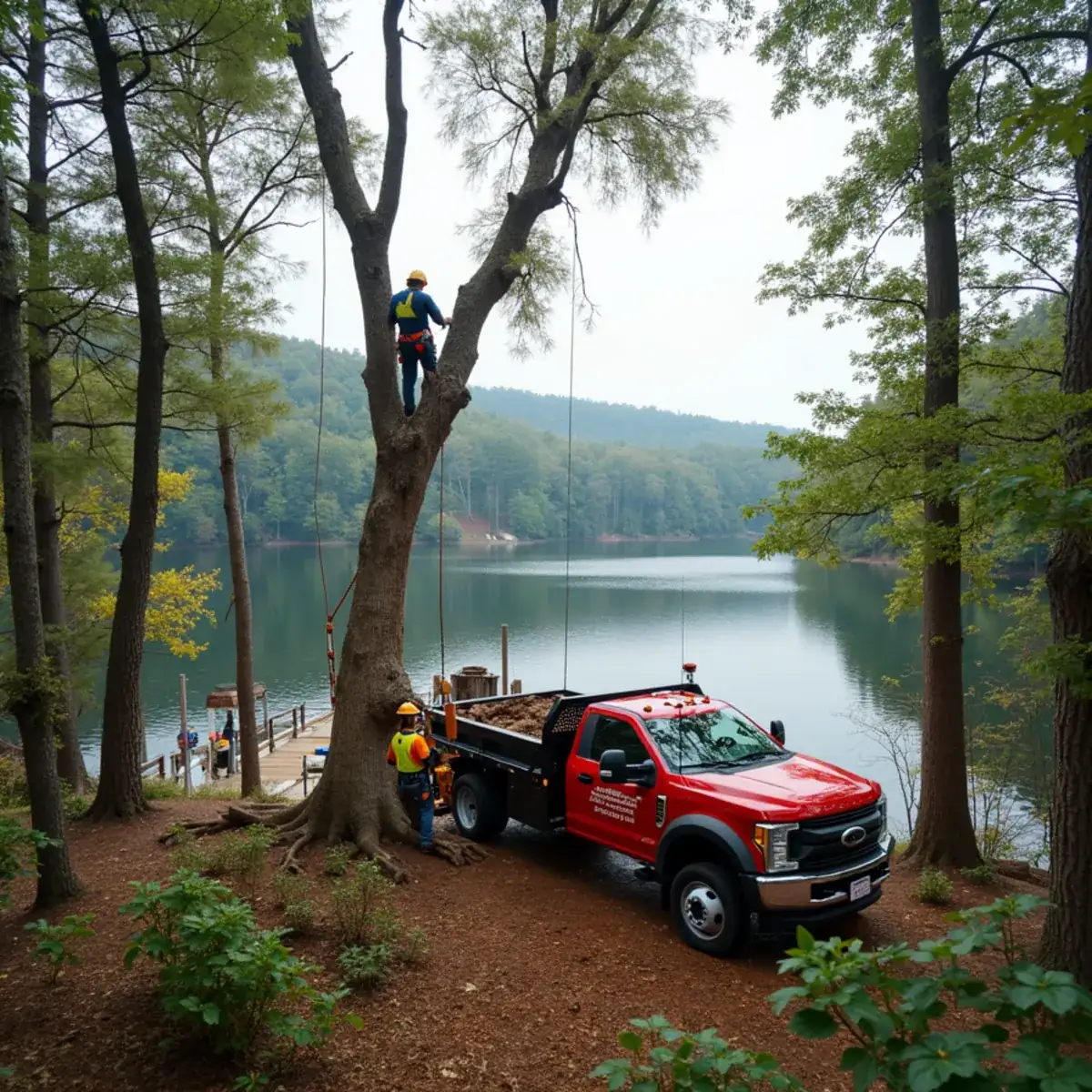
Often the right move is selective work, not removal — thinning or reducing a tree to relieve weight and open a view while keeping its stabilizing roots in the bank. When a tree genuinely must come out, our waterfront and shoreline tree care crews rig it up and away from the water so removal doesn't itself tear up the bank.
Warning signs your shoreline bank is failing
Bank collapse rarely happens without notice — the trees and soil usually telegraph it first. Walk your waterfront a couple of times a year and look for these tells:
- A shoreline tree leaning further over the water than it did last season
- Soil cracking, stepping, or slumping in an arc behind a trunk near the edge
- Roots increasingly exposed where wave action has washed soil out from under them
- Bare, unvegetated stretches of bank where groundcover has been cleared or died
- Dead or beetle-killed shoreline pines whose roots are no longer holding
- A noticeable overhang or undercut where the water has eaten in beneath the turf
Keeping the view without losing the bank
You don't have to choose between a lake view and a stable shoreline — you just have to open the view the right way. Instead of clearing the bank, we thin and limb selectively: raising a canopy to reveal the water beneath it, removing a few strategic stems rather than the whole screen, and reducing a leaning tree's weight instead of taking it out entirely. Where a tree truly has to go, we replace its stabilizing function by encouraging lower vegetation or replanting deeper-rooted natives back from the edge. Done within the Duke Energy buffer rules, this keeps your sightline open, your bank anchored, and your project on the right side of the shoreline management plan.
Rebuilding a bank that's already slipping
If your Lake Keowee bank has started to erode, the fix is almost always to add root structure, not strip it away. Bare, unrooted soil is what washes; a layered mix of deep- and shallow-rooted vegetation is what holds. A stabilization approach that stays inside the Duke Energy buffer usually combines:
- Keeping the healthy trees whose roots are still anchoring the bank, and reducing rather than removing the ones that only need weight taken off
- Re-vegetating bare stretches with deep-rooted native shrubs and grasses that knit the soil together
- Leaving a natural buffer strip at the water's edge instead of mowed turf, which has almost no holding power
- Directing downspouts and yard runoff away from the top of the bank, since concentrated water is what carves it
- Addressing undercut spots before a heavy tree above them fails and takes bank with it
- Checking what the Duke Energy Shoreline Management Plan requires before planting or grading at the water's edge
Respect the buffer
Duke Energy's Shoreline Management Plan governs what can be cut at the water's edge on Keowee. Owners around Seneca should confirm what's allowed before any shoreline project — we help you stay compliant and keep your bank both beautiful and stable.
Need help from a real Upstate tree crew?
Free estimates, 24/7 emergency response, fully insured. Call Rig Line Tree Service today.
Frequently asked
Yes — a network of tree and shrub roots binds shoreline soil against wave action and the lake's rise and fall. It's the main reason clear-cutting the water's edge for a view so often leads to an eroding, slumping bank a few seasons later.
Absolutely, by doing it selectively — raising canopies, removing a few strategic stems, and reducing leaning trees rather than clearing the bank. That opens the sightline while keeping the stabilizing roots in place, and stays within the buffer rules.
A new or worsening lean, especially with soil cracking behind the trunk or roots exposed by washout, is a real warning sign and worth an assessment. A long-standing lean on a stable root plate may be fine. We can tell you which you're looking at.
On Lake Keowee, the water's-edge buffer falls under Duke Energy's Shoreline Management Plan, and some work needs authorization. We help you confirm what's allowed for your lot before any cutting so a view project doesn't become a violation.
Often yes. The fix is usually to add root structure, not subtract it: keeping the trees that are still holding, re-vegetating bare stretches, and reducing (rather than removing) leaning trees to relieve weight. We assess what's driving the erosion and build a plan that stabilizes the bank while staying inside the buffer rules.