
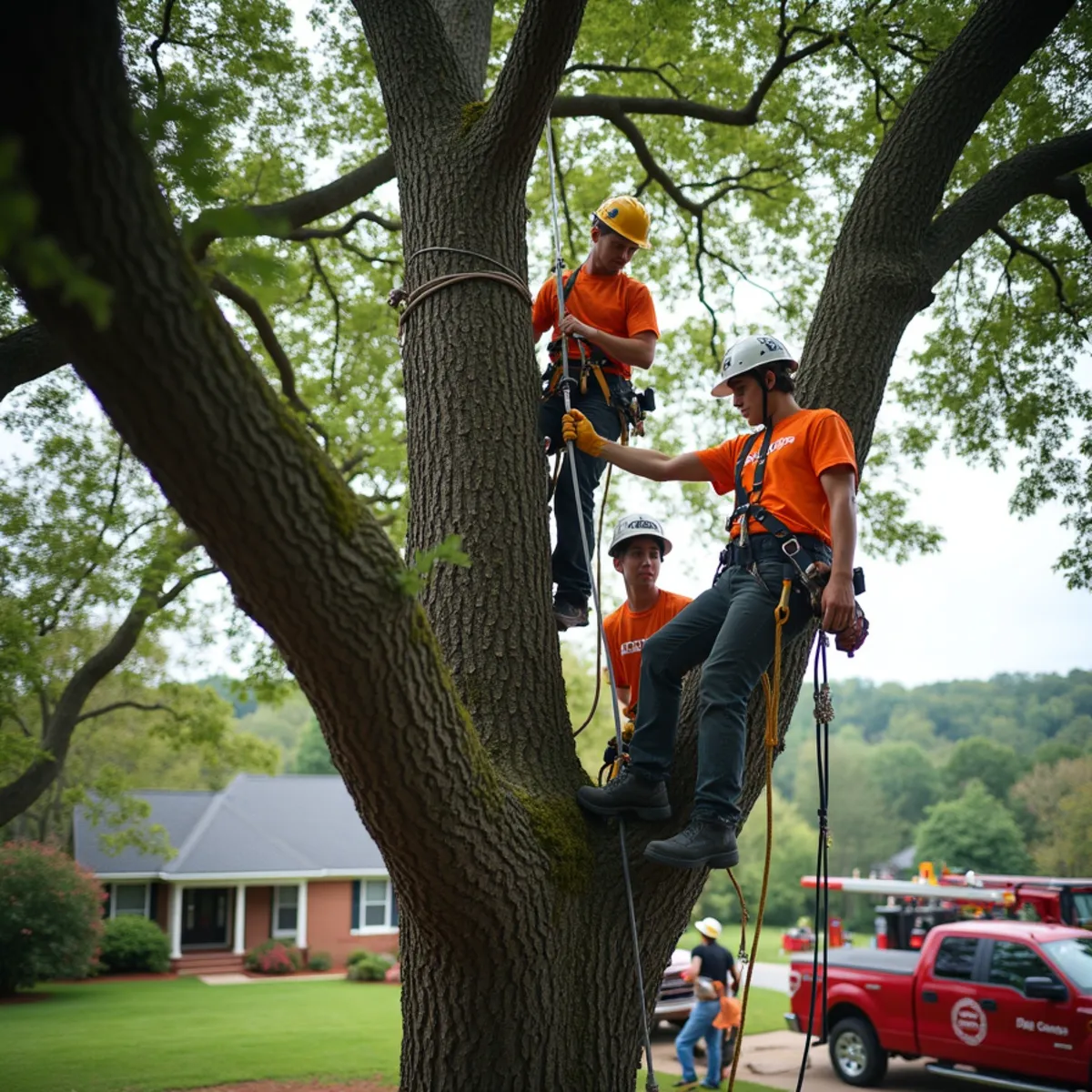
Not every structurally weak tree has to be removed. A heritage oak with a cracked fork, a double-leader maple splitting at the union, a long horizontal limb reaching over the roof — these are often savable with cabling and bracing: hardware that redistributes the load so the tree can hold itself through the next ice storm or straight-line wind. Rig Line Tree Service installs support systems in trees across Westminster and the Upstate, and we will tell you honestly when a tree is worth saving and when it is not.
- Fully licensed & insured
- Free written estimates
- 24/7 emergency response
- Serving all of Upstate South Carolina
What cabling and bracing actually do
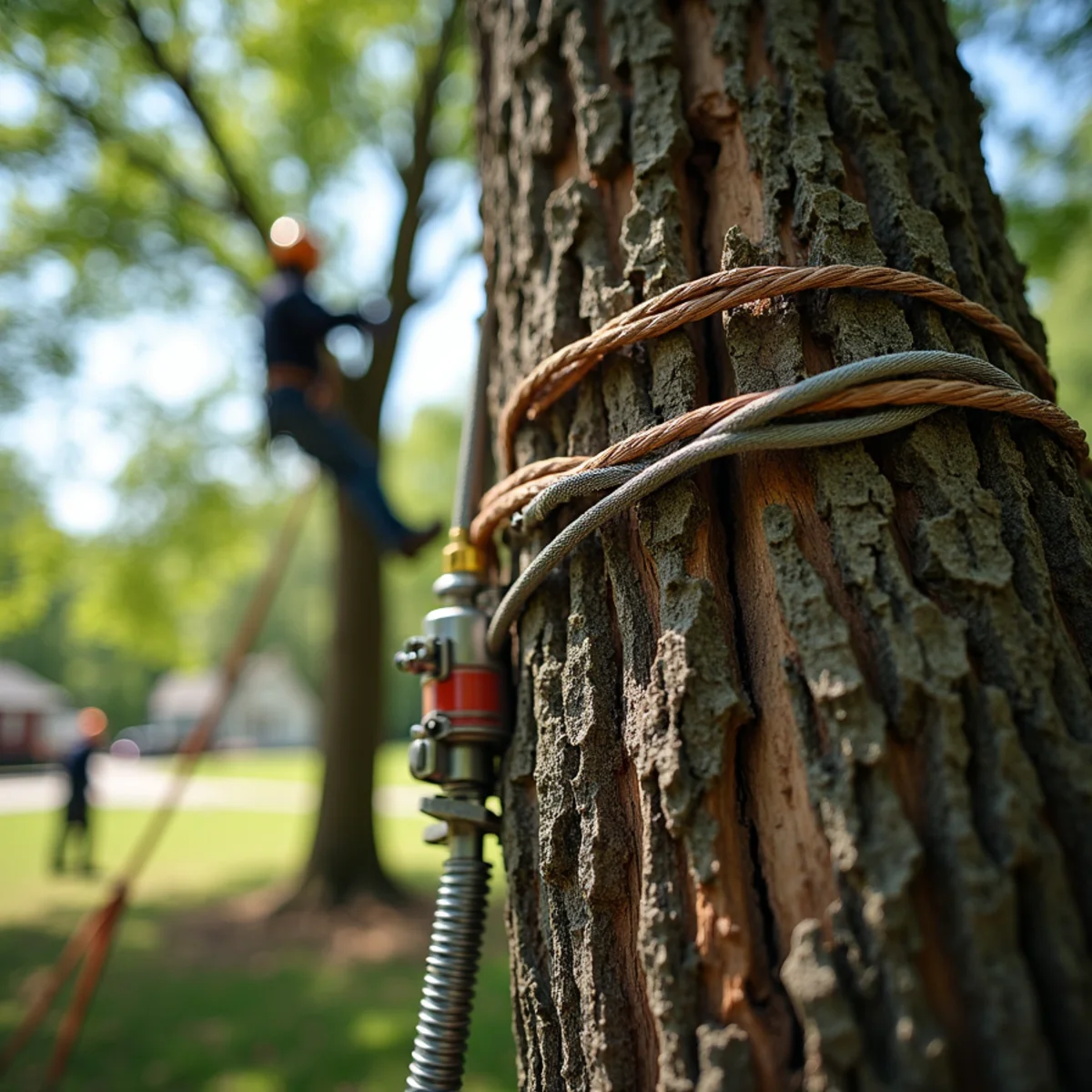
Cabling and bracing are two tools for the same goal: keeping a structurally weak part of a tree from failing. A cable is a flexible steel line installed high in the canopy between two limbs or leaders — it limits how far they can move apart in the wind, so a weak union is never loaded to its breaking point. A brace is a rigid steel rod threaded through the wood at or below a split or crack, bolting the two halves together to stop the crack from spreading. Serious cases often use both: a brace to hold a split closed and a cable above it to keep wind load off the repair.
The trees worth saving
Hardware is not a cure for a dying tree, and it is not a way to cheat physics on a tree that is already failing. Where it earns its place is on structurally flawed but otherwise healthy trees — usually mature, high-value ones whose removal would change a whole property.
- Double-leader (co-dominant) trunks with a tight, bark-included V-union
- Heritage oaks and hardwoods with a developing crack or seam at a major fork
- Long, heavy horizontal limbs extending over a roof, drive, or patio
- Trees that have already partially split and can still be drawn closed
- Specimen trees whose shade, privacy, or character is worth protecting
When bracing is the wrong answer
We would rather lose a job than sell you hardware that won't hold. If a trunk is hollow, if decay has eaten the wood a brace would have to bite into, or if the lean and root condition mean the whole tree is going over regardless, cabling only delays the failure — and gives you a false sense of safety in the meantime. In those cases we say so and talk through tree removal or a hazardous-tree assessment instead. Honest is cheaper for you in the long run.
How the Upstate's weather makes the case
Two things drive tree failure around here, and cabling addresses both. The first is ice: a glaze storm off the Blue Ridge loads a canopy with hundreds of extra pounds, and a weak union that holds fine all summer lets go under the weight. The second is wind — the straight-line gusts that come off Lake Keowee and Lake Hartwell and funnel through the foothills. A properly placed cable keeps a vulnerable fork from being levered open by either one, which is exactly when an unsupported tree tends to fail.
Inspection and re-tightening
A support system is not install-and-forget. Hardware should be looked at every couple of years and after any major storm, because the tree keeps growing around it and the loads change. When we install a cable or brace we note what we put in and where, and we check it on any return visit so the system is still doing its job years later.
Our process
- 1
Assess the defect
We climb or glass the tree, find the weak union or crack, and judge whether the wood around it is sound enough to hold hardware.
- 2
Design the system
We decide cable, brace, or both, and where each goes — high enough to control movement, deep enough into sound wood to carry the load.
- 3
Install to standard
Hardware goes in by climbers, sized to the tree's diameter and span — not a couple of eye bolts from the hardware store.
- 4
Document & revisit
We record what we installed and inspect it on future visits and after major storms, re-tensioning as the tree grows.
What affects the price
We don't post fake flat rates — every job is different. Instead, here's what goes into your free written estimate, so you understand exactly what you're paying for:
- Number of cables and braces the tree actually needs
- Tree height and how far climbers must work to reach the union
- Diameter of the limbs or leaders being tied together
- Whether an existing split has to be drawn closed before bracing
- Access for climbing on foothill, lakefront, or tight town lots
Why choose Rig Line Tree Service for tree cabling & bracing
We save the trees we can save
Rope work is our trade, and installing support high in a canopy is climbing work — so when a tree is genuinely worth keeping, we have the skill to keep it standing.
Straight answers, both ways
We tell you when hardware will hold a valuable tree together and, just as plainly, when the honest call is removal. We don't sell cables that only delay a failure.
Installed to standard
Cables and braces go in sized to the tree and placed where they actually carry load — the difference between a support system and a gadget.
We come back and check
A support system has to be inspected as the tree grows and after big storms. We document what we install so it keeps doing its job for years.
Get your tree cabling & bracing quote today
Insured local crews, free written scopes, and real 24/7 emergency response across Upstate South Carolina.
- Licensed & insured
- Free written estimates
- 24/7 emergency
Where we provide tree cabling & bracing
We install and inspect tree support systems throughout Westminster and Oconee County, and across the Upstate in Seneca, Clemson, Walhalla, and the Lake Keowee and Lake Hartwell communities where heritage hardwoods and lakeside winds make cabling worth the call.
FAQ
Tree Cabling & Bracing questions
Often, yes — if the split is caught before it runs too far and the surrounding wood is still sound. A brace draws the halves together and a cable above it keeps wind and ice from reopening the crack. If the trunk is hollow or decayed, though, hardware won't hold, and we'll tell you so.
A properly installed system can serve a tree for many years, but it isn't permanent or maintenance-free. The hardware should be inspected every couple of years and after major storms, and re-tensioned as the tree grows. We note what we install and check it on return visits.
For a large, high-value tree it usually is — and it keeps the shade, privacy, and character a removal would take with it. On a smaller or already-failing tree, removal can be the better value. We give you an honest comparison for your specific tree.
Installed correctly, no. Trees seal over properly placed hardware, and the small amount of wood a brace passes through is far less damaging than the limb failure it prevents. It's worth having a climber do it to standard rather than improvising with hardware-store parts.
It comes down to the condition of the wood around the defect and the overall health of the tree. A free assessment answers it — we read the union, check for decay, and tell you honestly whether support will hold or whether the safe call is removal.